Carlo Werner · 26 September 2026
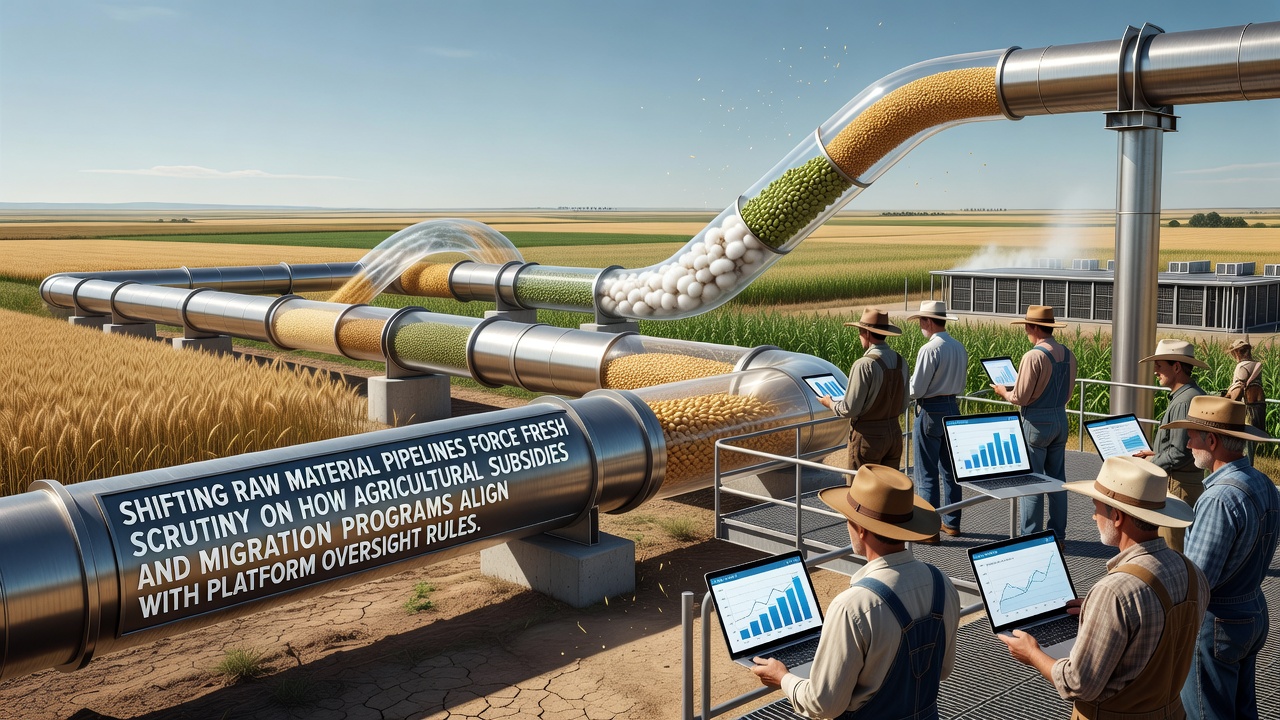
Shifting Raw Material Pipelines Force Fresh Scrutiny on How Agricultural Subsidies and Migration Programs Align With Platform Oversight Rules
Changes in global raw material supply routes have prompted government agencies and international bodies to examine connections between agricultural support systems, labor mobility schemes, and digital platform regulations during September 2026. Data from trade monitoring organizations show that disruptions in energy and mineral transport networks have altered input costs for farming operations across multiple continents, which in turn affects how subsidy allocations respond to price volatility.
Supply Chain Pressures Reshape Policy Intersections
Observers note that pipeline rerouting for commodities such as fertilizers and feedstocks has created new cost structures for producers, and these adjustments coincide with updates to migration frameworks designed to fill seasonal labor gaps. Government records indicate that several member states began coordinating subsidy reviews with labor permit adjustments in early 2026, while platform oversight bodies simultaneously refined content and data rules that govern how agricultural market information reaches stakeholders.
Research from the Organisation for Economic Co-operation and Development highlights that raw material price swings reached 18 percent year-over-year volatility in the second quarter of 2026, and analysts link part of that movement to pipeline capacity constraints in key transit corridors. Those same fluctuations have led agricultural ministries to recalibrate payment formulas, and migration authorities have adjusted quota calculations to match revised planting and harvest projections.
Regulatory Alignment Efforts Across Regions
European Commission documents detail joint working groups that began meeting in July 2026 to map overlaps between farm support programs and digital services legislation. Parallel initiatives in North America and the Asia-Pacific region have examined how online marketplaces disclose subsidy-related data and worker recruitment terms. Figures released by the US Department of Agriculture show that compliance reporting requirements for certain digital platforms expanded in August 2026, requiring clearer attribution of government payments within transaction records.
One study released by the Australian Bureau of Agricultural and Resource Economics and Sciences found that labor migration approvals tied to commodity price thresholds increased by 12 percent between January and September 2026. The same report notes that platform operators handling farm equipment marketplaces must now provide audit trails that link subsidy claims to verified labor inputs, a requirement introduced to reduce discrepancies in cross-border supply documentation.

Data Transparency and Platform Obligations
Platform oversight rules now require certain marketplaces to flag listings that reference public subsidy programs, and enforcement agencies have issued guidance on how migration program data should appear in those disclosures. Industry associations report that software updates rolled out in September 2026 enabled automated tagging of subsidy-linked transactions, which regulators can cross-reference against labor permit databases. This technical integration aims to close gaps where raw material cost changes might otherwise distort reported farm incomes.
Case examples from Canadian provincial programs illustrate how pipeline delays for potash shipments prompted temporary top-up payments that migration offices then used to recalculate temporary foreign worker allocations. Digital platforms hosting these program details were required to update their interfaces within 30 days of the policy shift, according to notices issued by provincial agriculture departments.
International Coordination Patterns
Meetings hosted by the World Trade Organization in Geneva during the summer of 2026 addressed how subsidy notifications should incorporate supply chain data from pipeline operators. Participants examined templates that link raw material transport statistics with migration program statistics, and several delegations proposed standardized reporting formats for platform operators who aggregate such information. The discussions built on earlier frameworks but introduced new fields for pipeline capacity metrics that were absent from previous notification cycles.
Trade data compiled by the International Grains Council shows that wheat and maize producers in affected regions adjusted planting decisions based on revised subsidy projections, while recruitment agencies updated their migration outreach materials to reflect those planting changes. Platform rules governing recruitment advertising now include provisions for displaying the underlying subsidy assumptions that inform labor demand forecasts.
Conclusion
September 2026 marks a period when multiple policy streams have converged around shifting raw material logistics, and agencies continue to refine the mechanisms that connect agricultural subsidies, migration programs, and platform oversight. Government datasets and international reports document ongoing adjustments to reporting requirements, data-sharing protocols, and compliance timelines as supply networks stabilize. These developments reflect coordinated responses to measurable changes in transport capacity and input costs rather than isolated policy experiments.